


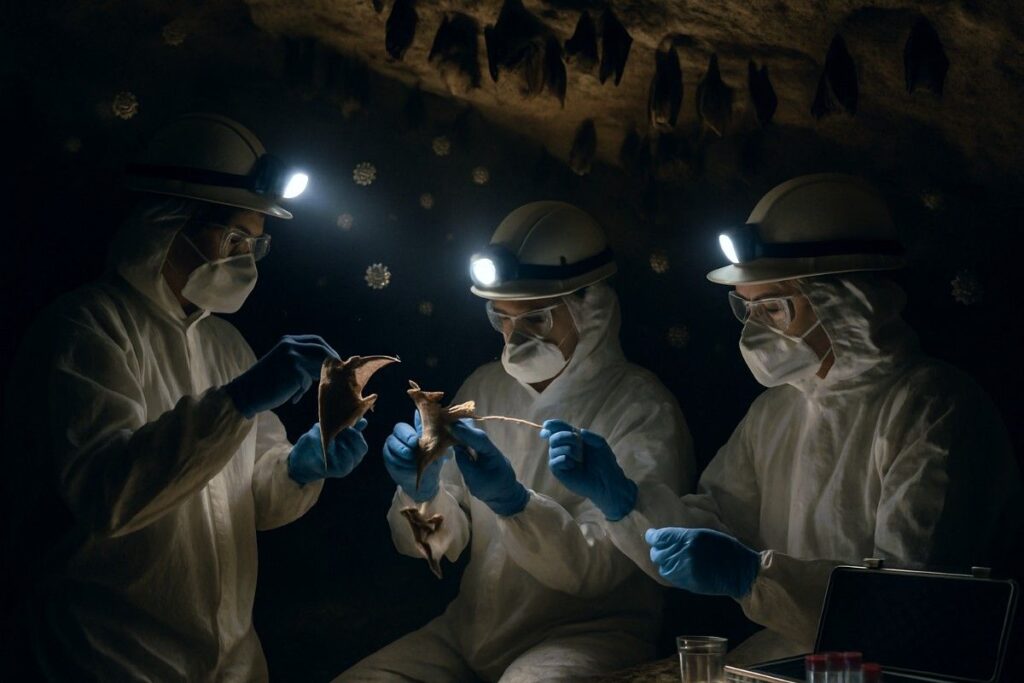
Beijing, August 27, 2025 — A major virological study in Yunnan province, China, has revealed the presence of 20 previously unknown bat viruses, including two closely related to the deadly Nipah and Hendra viruses. The discovery has sparked international concern about the potential for future spillover events, underscoring the ongoing need for pandemic preparedness.
Dangerous Parallels With Nipah and Hendra
The newly identified viruses belong to the Henipavirus family, the same group that includes Nipah and Hendra — pathogens notorious for their high fatality rates and history of causing devastating outbreaks in South and Southeast Asia.
- Nipah virus has a mortality rate ranging between 40% to 75%, with past outbreaks reported in Bangladesh, India, and Malaysia.
- Hendra virus, first identified in Australia, is equally dangerous, affecting both horses and humans.
Though the newly discovered bat viruses have not yet been shown to infect humans, scientists caution that their genetic similarity to Nipah and Hendra places them in the category of “high-risk emerging pathogens.”
The Discovery
The viruses were found during a large-scale surveillance study conducted by Chinese researchers, who sampled bats in orchards and caves across Yunnan province — a hotspot for wildlife-human interactions.
Testing revealed traces of the viruses in bat kidney tissues, raising concerns that they could spread through urine contamination of fruit, soil, or water sources. This mode of transmission is similar to the way Nipah outbreaks have occurred in the past, when people consumed fruit or date palm sap contaminated by bat secretions.
Dr. Zhang Wei, a lead researcher on the project, told local media:
“Our findings do not confirm human infections at this stage, but the genetic makeup of these viruses demands caution. Close monitoring and ecological management are essential to reduce the risk of spillover.”
A Reminder of Pandemic Risks
The discovery comes at a time when the global community is still recovering from the COVID-19 pandemic. Experts stress that emerging viruses from wildlife reservoirs, especially bats, remain among the greatest threats to global health security.
Professor Lin Qiaoying, an epidemiologist at Peking University, explained:
“Bats play a critical ecological role, but they are also natural hosts for many dangerous viruses. Human encroachment into bat habitats increases the chances of spillover. This is not a matter of ‘if,’ but ‘when.’”
International Response
The findings have already drawn attention from the World Health Organization (WHO) and international virologists, who are urging stronger collaboration on surveillance and transparent data-sharing.
Dr. Michael Ryan, Executive Director of WHO’s Health Emergencies Programme, commented in Geneva:
“The identification of these new henipaviruses is a stark reminder that nature continues to test our defenses. We must invest in early warning systems, expand laboratory capacity, and strengthen cross-border cooperation before the next spillover occurs.”
Calls for Preventive Action
Experts are recommending a multi-pronged approach:
- Enhanced Surveillance: Routine monitoring of bat populations in Asia and Africa.
- Public Awareness: Educating communities in high-risk regions about safe farming and food practices.
- Habitat Protection: Preserving bat ecosystems to reduce human-animal contact.
- Vaccine Research: Accelerating efforts to develop broad-spectrum vaccines against the henipavirus family.
A Global Wake-Up Call
This discovery of 20 new viruses — particularly two that are closely related to some of the deadliest known zoonotic pathogens — has reignited the debate about humanity’s preparedness for future pandemics.
For now, there is no evidence of human infection. But researchers warn that without vigilant monitoring, ecological responsibility, and global cooperation, the world could once again be blindsided by a deadly new virus.
👉 With the memory of COVID-19 still fresh, the message from scientists is clear: the next pandemic threat may already be hiding in the forests and caves of Yunnan.